


Discover Our Popular Courses
Learn programming with free online courses from real college courses from Harvard, MIT, and more of the world's leading universities. Pick up essential coding skills needed for frontend and/or backend web development, machine learning, iOS, Android, and much more. So buy our course and create yourself as a strong programming developer!

Fundamental Of UI/UX Design
User experience (UX) focuses on having a deep understanding of users, what they need, what they value, their abilities, and also their limitations. It also takes into account the business goals and objectives of the project.
Price: $20
Last updated 3 mins ago
JavaScript Basic to Advanced
It is a very powerful client-side scripting language that makes your webpage more lively and interactive. It is a programming language that helps you to implement a complex and beautiful design on web pages. Start with JavaScript.
Price: $20
Last updated 3 mins ago
Fullstack Web Development
A full stack web developer is a person who can develop both client and server software. In addition to mastering HTML and CSS, they also need to understand how to: - Program a browser (using JavaScript, jQuery, Angular, or Vue). - Program a server (handling backend technologies).
Price: $20
Last updated 3 mins ago
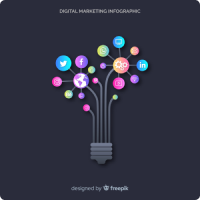
Digital Marketing
Digital marketing is a core component of modern marketing, leveraging the Internet and online-based technologies such as desktop computers, mobile phones, and other digital media platforms to promote products and services.
Price: $20
Last updated 3 mins ago

Photography Basic Rules
As a photographer, what viewers see in your pictures is entirely up to you. Beyond choosing a camera, settings, and shutter timing, you decide where to frame your shots. Develop your photography skills through this course and improve your creative vision!
Price: $20
Last updated 3 mins ago
Motion Graphics
Motion graphics are pieces of animation or digital footage that create the illusion of motion or rotation. They are often combined with audio for use in multimedia projects and are commonly displayed via electronic media technology.
Price: $20
Last updated 3 mins ago

Explore Thish Programming Community Institute
If tech is a gold mine, Computer Science is your shovel. Fortunately, this Path teaches you college-level fundamentals, so you can start thinking and coding like a professional in no time.
-
You will:
- Learn Python, Command Line, Git, Data Structures, and more.
- Understand how to write super-efficient code.
- Problem-solve like a pro.
- Build a professional portfolio.
3.2K+
Online Course
600+
Expert member
1k+
Rating & Review
Ready to join?
We help organizations of all types and sizes prepare for the path ahead—wherever it leads. Our curated collection of business and technical courses help companies, governments, and nonprofits go further by placing learning at the center of their strategies.
Meet Our Successful Students
It is a long-established fact that a reader will be distracted by the readable content of a page when he or she is looking at the success rate of our course. So, we showcase some of our successful student portfolios!

Awlad Hossain
UI/UX Designer

Jannatul Islam
Motion Designer

Imran Hossain
Graphic Designer

Nishi Akter
Web Developer
Some Students Feedback
Whether you want to learn or to share what you know, you’ve come to the right place. As a global destination for online learning, we connect people through knowledge.

Pro Edu fit us like a glove. Their team curates fresh, up-to-date courses from their marketplace and makes them available to customers. In total, it was a big success, I would get emails about what a fantastic resource it was.

Pro Edu responds to the needs of the business in an agile and global manner. It’s truly the best solution for our employees and their careers. In total, it was a big success, I would get emails about what a fantastic resource it was.

Frequently Asked Questions
It is a long-established fact that a reader will be distracted by the readable content of a page when looking at its layout.
The basic difference between CSS Grid Layout and CSS Flexbox Layout is that flexbox was
designed for layout in one dimension—either a row or a column.
Grid was designed for two-dimensional
layout - rows, and columns at the same time.
The two specifications share some common features, however, and if you have already learned how to use
flexbox,
the similarities should help you get to grips with Grid.
Tailwind CSS
1. Tailwind offers predesigned widgets to build a site from scratch with fast UI development.
2. Tailwind CSS uses a set of utility classes to create a neat UI with more flexibility and
uniqueness.
3. Projects created using Tailwind CSS are much more customizable.
4. Tailwind CSS is relatively new, and its community is expanding rapidly, with increasing
references, tools, and adoption.
5. Tailwind CSS requires only its base stylesheet file (~27KB), making it lightweight.
6. Tailwind CSS is used by companies like BlaBlaCar, Exyplis, and Bazzite.
Bootstrap
1. Bootstrap provides pre-styled responsive, mobile-first components within a defined UI kit.
2. Sites created using Bootstrap often follow generic design patterns, making them look similar.
3. Websites built with Bootstrap are known for their responsiveness and flawless design, but often
lack uniqueness.
4. Bootstrap is time-efficient and has been the most popular CSS framework for over nine years, with
a large developer community.
5. Bootstrap requires four files (jQuery, Popper.js, Bootstrap JS, Bootstrap CSS) totaling ~308KB.
6. Large companies like Spotify, Twitter, and Lyft use Bootstrap.
In web development, the
CSS box model refers to how HTML
elements are modeled in browser engines and how the dimensions of those HTML elements are
derived from CSS properties.
It is a fundamental concept for the composition of HTML webpages.
The guidelines of the box model are described by web standards from the World Wide Web Consortium (W3C),
specifically the CSS Working Group.
For much of the late-1990s and early 2000s, there were non-standard implementations of the box model
in mainstream browsers.
With the advent of CSS2 in 1998, which introduced the box-sizing property,
the problem was mostly resolved.
HTML was originally created as a markup language to describe documents on the early
internet.
As the internet grew and was adopted by more people, its needs changed.
Where the internet was originally intended for sharing scientific documents, people soon wanted to share other types of content and enhance the visual presentation of web pages.
Because the web was not initially built for advanced design, programmers used various workarounds to structure content visually. Instead of using
table elements solely for tabular data, developers
repurposed
them to control the layout of web pages.
As visually designed layouts became more common, developers frequently relied on generic “non-semantic” tags like
div. These elements were often given class or ID attributes to describe their intended
purpose.
For example, instead of using header, it was common to write div class="header".
With the introduction of
HTML5, semantic tags such as `Trusted by over 800+ companies